Index
Read UML Class Diagrams as Sentences
UML has been around for a long time, and among all UML diagrams, the class diagram is probably the one that still survives in real-world development.
And yet, every time we read or draw one, we get stuck on the same things:
- What does this arrow mean again?
- Which direction is correct?
- How should I read “dependency”, “association”, and “aggregation”?
I don’t think this confusion comes from a lack of UML knowledge.
The real problem is that we don’t share a rule for how to read a class diagram.
So I made a cheat sheet to fix that.
This cheat sheet:
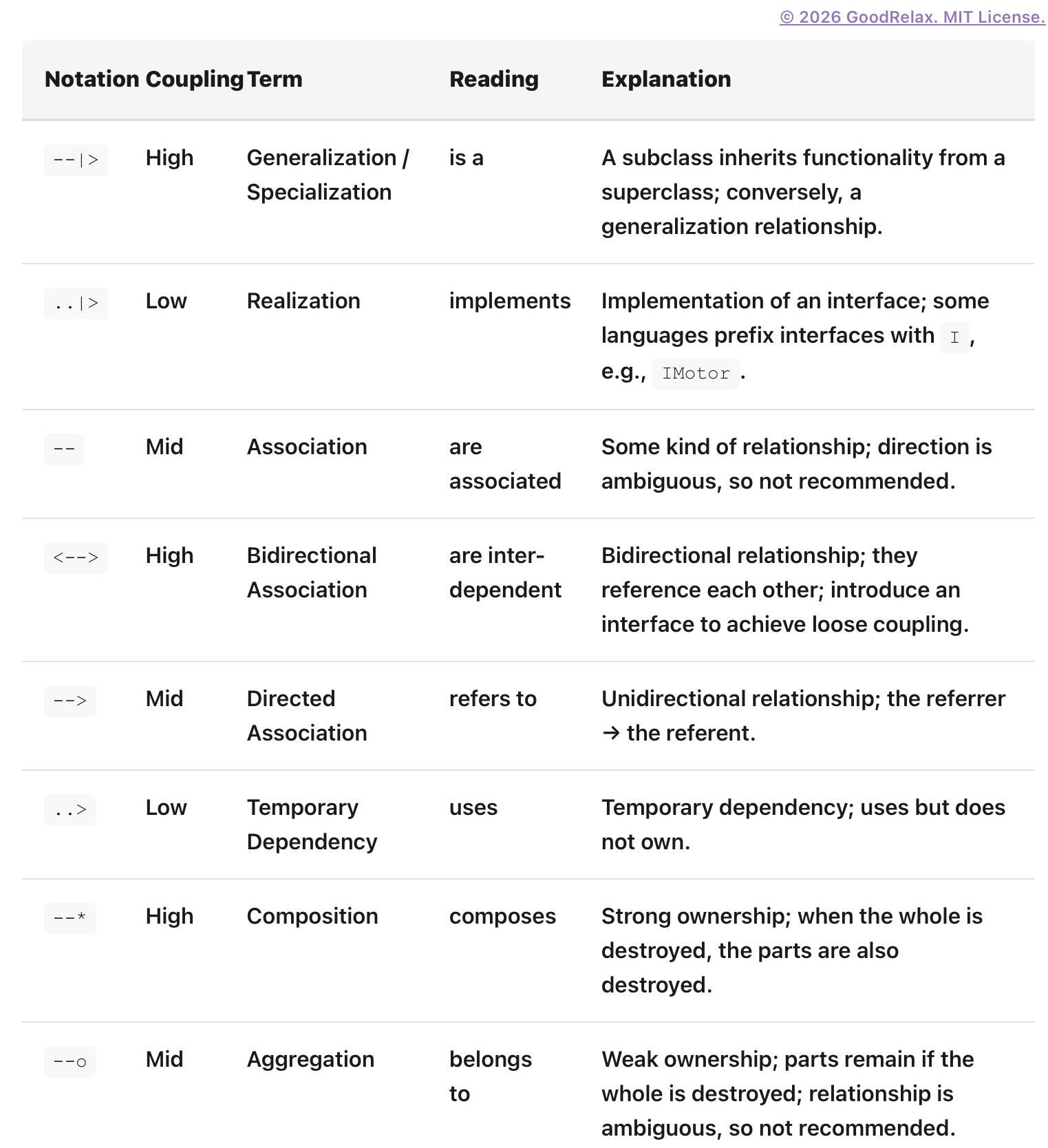
- Covers all arrows used in UML class diagrams
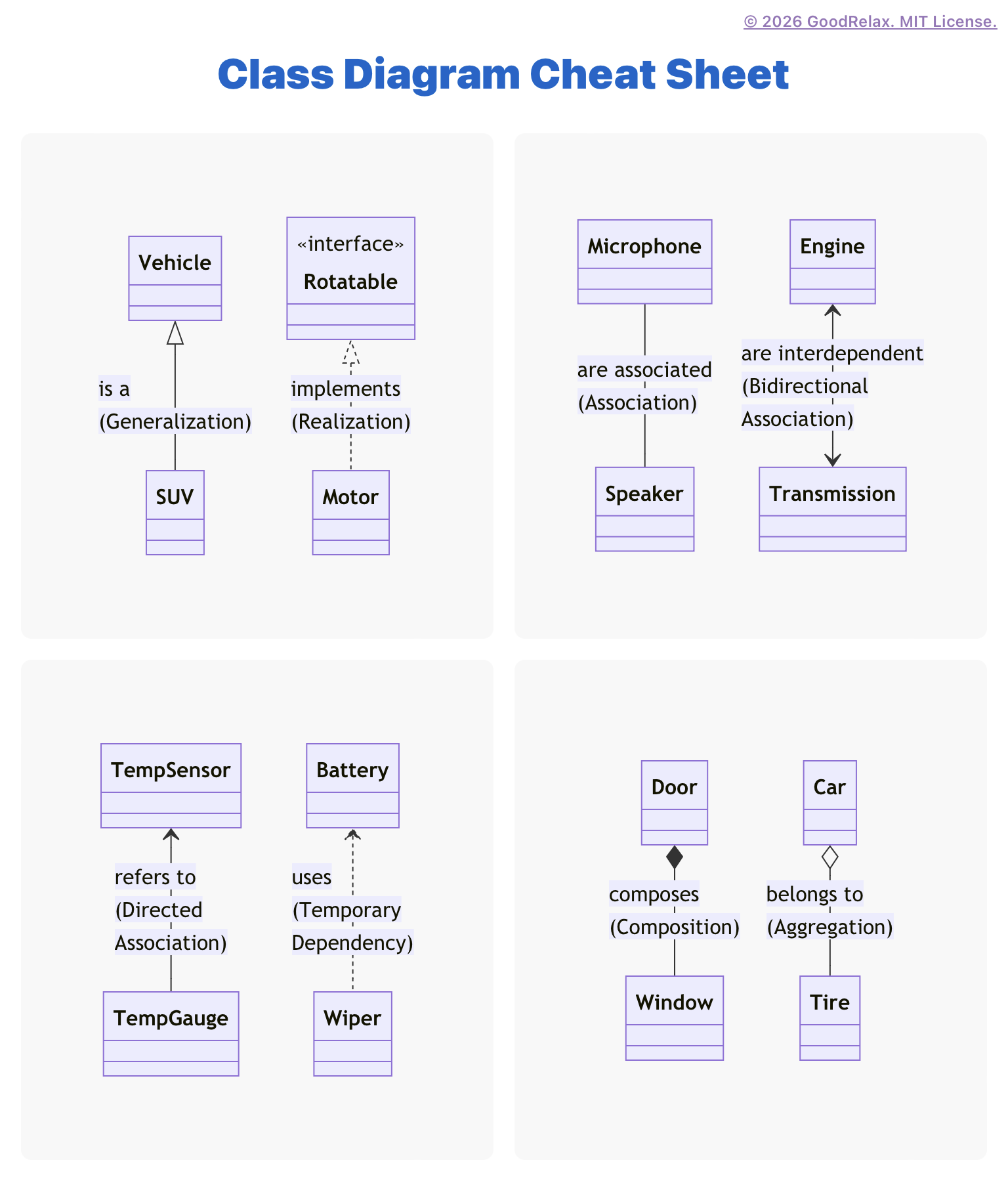
- Defines a simple template to “read arrows as sentences”
- Reduces confusion when reading and writing class diagrams
The Cheat Sheet
Cheat sheet: https://goodrelax.github.io/gr-cheat-sheets/uml/class-diagram-cheat-sheet-en.html
It summarizes every arrow used in UML class diagrams and how to read them.
I also added sample code in C++, JavaScript, and Python to show how each relationship appears in actual code.
The Key Idea: Read Arrows as Sentences
For every arrow, read it using this template:
Subject (start) + Verb (arrow type) + Target (end)
The “target” can be either an object or a complement depending on the relationship.
That’s it.
By doing this, a class diagram stops being a “picture” and becomes a set of readable sentences.
Two rules matter:
- The start of the arrow is always the subject
- Choose a verb that matches the arrow type and direction
Once this rule is shared, misreading class diagrams almost disappears.
Why This Works So Well
Faster Reviews
You can instantly verbalize what the diagram means.
Easier to Spot Design Mistakes
When you turn it into a sentence, awkward designs become obvious.
For example:
“PaymentData refers to Repository”
If you can read it like this, you immediately feel something is wrong.
Easier to Check DIP (Dependency Inversion Principle)
Because you can read dependencies as sentences, it becomes much easier to see where the design intent is broken.
Do We Still Need Class Diagrams in the Age of AI Coding?
AI is getting better at coding.
We are heading toward a world where:
- Humans do high-level thinking
- AI designs
- Other AIs implement and test
Even then, humans will still be responsible for:
- Reviewing designs
- Monitoring structure
- Checking dependencies
At that point, the ability to read class diagrams as sentences becomes even more important.
Conclusion
Understanding class diagrams is not about UML knowledge.
It’s about having a rule for how to read them.
I hope this template helps reduce the time you spend being confused by class diagram arrows.
Cheat Sheet Preview
Here are the most commonly used parts of the cheat sheet.
For full details and sample code, see: https://goodrelax.github.io/gr-cheat-sheets/uml/class-diagram-cheat-sheet-en.html